
How 3D Pool Design Prevents Construction Mistakes
 JC Escudero: Sep 23, 2026
Planning a custom pool involves dozens of decisions about shape, depth, materials, and features. Get one wrong, and you could face expensive rework...
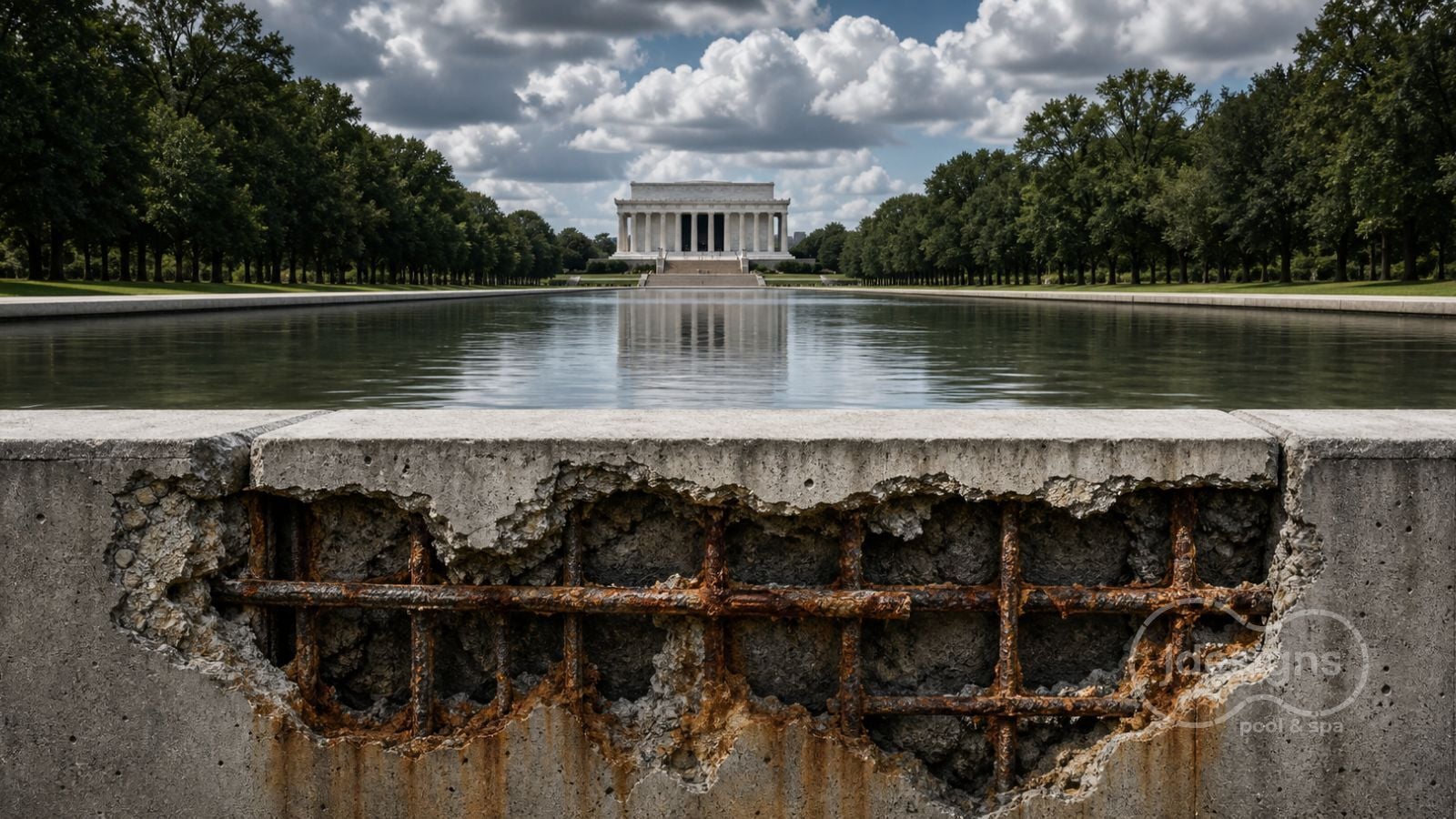
The Lincoln Memorial Reflecting Pool is not only one of the most recognizable water features in the United States. It was designed on the National Mall as a formal water mirror between two national monuments: the Lincoln Memorial at one end and the Washington Monument at the other.
That design intent matters.
A reflecting pool is not simply a basin that holds water. It is a hydraulic, structural, and visual system that depends on stability, water quality, finish performance, and controlled surface conditions. When any one of those systems breaks down, the public sees the symptom. What they do not always see is the chain of conditions underneath it.
Recent headlines have focused on the peeling blue coating now visible at the Lincoln Memorial Reflecting Pool. From a pool and watershape professional’s perspective, that surface failure deserves attention, but it should not be analyzed in isolation. The more accurate question is not just why the coating peeled. It is the sequence of structural, hydraulic, material, and operational decisions that brought the pool to this point.
With more than two decades of experience working on pools, fountains, and water-holding structures, our view is straightforward: visible coating failure is often the last event in the chain, not the first.
The Reflecting Pool was dedicated in 1922. In its original form, it held approximately 6.75 million gallons of water. That is an enormous hydraulic and structural load, borne by a long, shallow basin built on marshland. Over time, the original pool sank, cracked, and leaked.
That history is important because it explains why the pool has required major intervention more than once. It also explains why any discussion about the current coating issue must be grounded in the full life cycle of the structure rather than a single recent repair campaign.
One point needs to be stated clearly for accuracy.
The present coating issue should not be treated as proof that the original 1922 concrete shell has now finally failed. That would overstate what is currently known.
The pool underwent a major reconstruction between 2010 and 2012. That project addressed the long-documented settlement and leakage issues that developed because the original pool had been built on unstable ground. Publicly available reports state that the reconstruction replaced the structure, added more than 2,100 timber supports, reduced the pool’s capacity to roughly 4 million gallons, and introduced a circulation and treatment system using the Tidal Basin as the primary water source.
That means today’s failure must be analyzed against the post-reconstruction pool and its later repairs, not against the untouched 1922 basin.
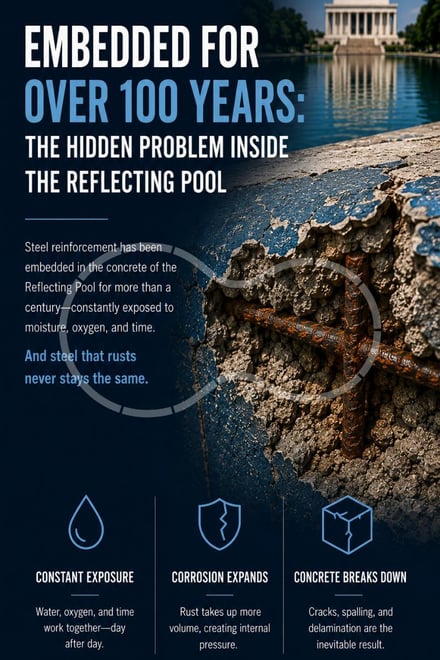
The pool was conceived as a long, calm surface intended to visually connect the Lincoln Memorial and the Washington Monument. Its purpose was aesthetic as much as hydraulic. Its dark color is an architectural detail that most reflecting pools in the world share, so they can reflect without showing the bottom or interior of the pool.
Because the original pool was built on marshland without the kind of deep support system later deemed necessary, it gradually sank. As that happened, the basin developed cracks and leaks. These were not cosmetic defects. They were structural and operational problems that affected how the pool held water and performed.
A major reconstruction effort replaced the structure and added deep timber support. The rebuilt pool was made shallower, reduced from roughly 6.75 million gallons to about 4 million gallons, and paired with a circulation and treatment system intended to improve sustainability and water quality.
From an engineering perspective, this was a fundamental reset, not a touch-up.
Even after the rebuild, algae problems did not disappear. Public reporting over the years continued to reference water quality struggles, maintenance issues, and long-term trouble with key system components, including expansion joints, leaking lines, and circulation-related challenges.
That is another important point. A rebuilt pool can still be operationally vulnerable if joints fail, pipes leak, circulation is compromised, or treatment is insufficient for real-world conditions.
In 2026, a new high-profile renovation introduced a blue polyurea-type coating and a nanobubbler- and ozone-based algae-control approach. Public reporting also indicates that significant attention was given to expansion joint repairs and waterproofing measures.
This is where the analysis has to become disciplined.
A coating system can be part of a sound repair strategy when the substrate, joint conditions, moisture profile, movement expectations, and sequencing all support that system. But "NO" coating should not be expected to solve unrelated hydraulic, joint, or maintenance failures on its own.
The pool was refilled in early June after the renovation work. This part of the story needs to be stated carefully and accurately.
The broader water source is tied to the Tidal Basin, which is connected to the Potomac River system. However, public records from the post-2012 redesign indicate that this was not intended to be a simple case of raw river water being pumped straight into the pool. The system was designed so that water drawn from the Tidal Basin would be screened, filtered, and treated before entering the Reflecting Pool, with potable city water available as a backup when source-water conditions were poor.
That distinction matters.
The red flag is not merely that nearby surface water was part of the supply strategy. The real concern is whether the treatment process, source-water decision-making, circulation performance, startup sequencing, and field execution were robust enough to deliver stable water quality under actual operating conditions.
From a pool professional’s perspective, that is where the conversation should be. If a large, shallow, high-visibility basin is vulnerable to algae within days of refilling, the problem is not just where the water came from. The problem is whether the overall water management plan was specific enough, disciplined enough, and professionally executed enough to control nutrients, turnover, sanitation, and reflectivity from day one.
Algae reportedly returned within days of refilling. That matters because it suggests the visual and water-quality objectives of the rehabilitation were not fully stabilized at startup. This is particularly a challenge in pools as well. Actively filtering and sanitizing the water before or during filling is a critical step, even though pool professionals often overlook it. A 20,000 gallon pool can easily be corrected, not a 4 million gallon pool.
In large shallow bodies of water, algae is rarely just a cosmetic nuisance. It is a signal that circulation, source water conditions, treatment strategy, nutrient load, thermal gain, or operational control may still be out of balance.
For the general public, the takeaway is simple: when algae growths this quickly after refill usually means the water system was not truly under control.
For owners of pools, fountains, and tanks containing water, the lesson is even clearer: filling a vessel is not the same as commissioning a water-quality system. A basin can be full and still be poorly prepared for stable operation.
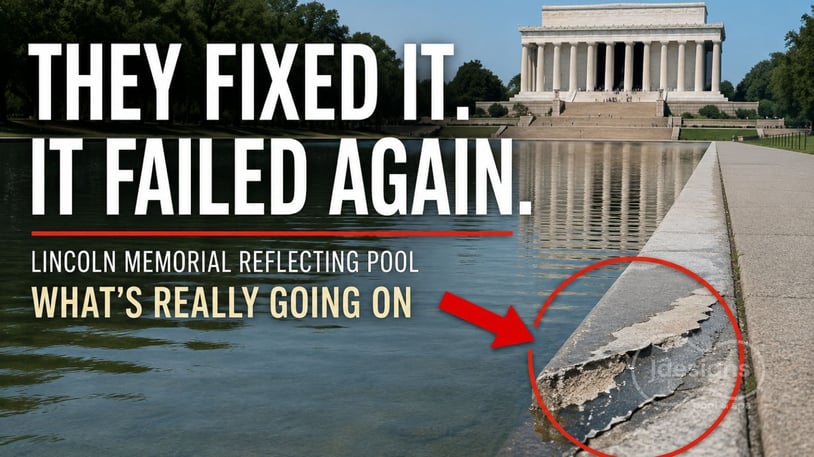
Public reports on June 18 showed visible peeling or delamination of the blue finish layer. At that point, the story became national news.
This is the moment many observers understandably focused on. But from a construction and watershape perspective, visible peeling is the beginning of the visible story, not the beginning of the actual failure sequence.
Public filings and news coverage also reference reported cuts to caulk over foam sealant on June 9, along with later claims of vandalism. Those claims should not be ignored. But they also should not be used to prematurely explain the entire failure.
At this stage, the most responsible position is that some reported physical damage may have occurred, while the full cause of the coating failure remains unproven.
That distinction matters.
A localized cut, damaged sealant, or interference by visitors may explain part of the distress. It does not automatically explain broad adhesion loss, finish separation, rapid visible peeling, or recurring water-quality instability across a large and complex basin.
Based on public reporting, several points appear reasonably clear:
Several major conclusions remain unproven and should not be stated as settled fact:
In other words, the current public record supports caution, not certainty.
From our perspective as pool and watershape professionals, the most defensible explanation is that such failures are often multifactorial.
When a pool finish system loses bond in a large submerged concrete structure, the likely causes typically fall into a short list of categories:
Not every waterproofing or coating product behaves the same way on every surface. Adhesion depends on the specific substrate, its profile, porosity, and cleanliness, as well as whether adjacent materials create transitions or weak points.
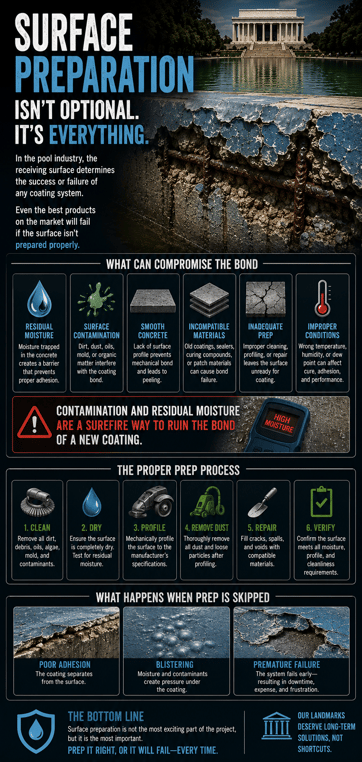
In the pool industry, surface preparation is not a minor detail. It is the foundation of the bond.
Residual moisture, contamination, insufficient profile, incompatible existing material, or incomplete removal of weak surface layers can all contribute to premature separation.
Any water-holding structure can experience moisture pressure not only from the pool side, but also from behind the finish system. If moisture migrates through or behind the substrate, the bond line becomes vulnerable.
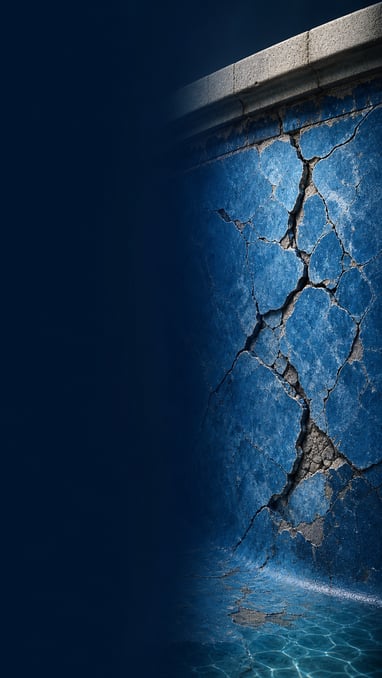
Large basins expand and contract. Joints exist for a reason. If movement is concentrated at repaired joints, perimeter transitions, or changes in material, the finish system may be asked to bridge conditions beyond what it can tolerate over the long term. This is a clear oversight we encounter in most pools as well.
Many advanced coating systems are highly sensitive to application timing, environmental conditions, thickness control, and intercoat bonding windows. On fast-moving projects, this becomes even more critical.
Finishes do not perform independently from the water environment they live in. Aggressive chemistry, oxidizers, algae-treatment interventions, poor turnover, stagnant zones, elevated temperatures, and unstable startup conditions can all add stress to a newly installed system.
If a basin has long-standing circulation limitations, water-source issues, leaking pipes, recurring algae pressure, or inconsistent treatment performance, a finish system may become part of a much bigger operating problem. Coatings cannot compensate for underperforming hydraulics.
This is not just a story about a famous pool in Washington.
It is a case study of a mistake we see repeatedly in the pool industry: treating the visible surface as though it is the whole system.
Whether the structure is a residential pool, a commercial fountain, a civic water feature, or a large tank, owners are often presented with finish-driven solutions before they have completed a proper structural, hydraulic, and moisture investigation. That is where expensive missteps begin.
A coating can be an excellent component in the right repair plan. It is not a substitute for diagnosis.
It is also a reminder that the water source, treatment, circulation, startup, and maintenance must be planned as a single coordinated system. That is especially true when a project is expected to remain visually flawless under intense public scrutiny.
For any large pool, fountain, or water-holding vessel, we believe the proper sequence should be:
Before selecting a coating, confirm the condition of the substrate, joints, waterproofing transitions, moisture movement, and structural behavior.
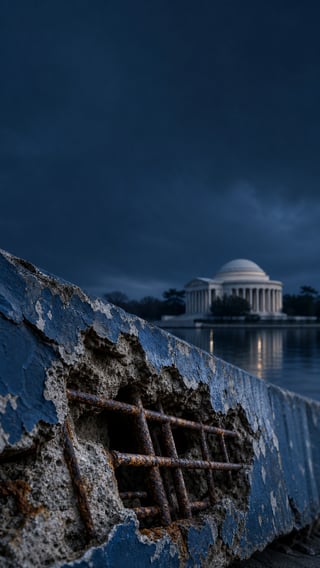
Determine whether the distress is primarily cosmetic, adhesion-related, joint-related, hydraulic, or structural. These categories overlap, but they are not interchangeable.
Circulation, turnover, stagnation zones, source water quality, pretreatment, temperature gain, and treatment strategy all influence finish durability and long-term performance. Most important is not to ignore filtration, as it is one of the most common mistakes related to water clarity.
Moisture testing, bond testing, and compatibility review are not optional on critical submerged structures.
Any repair strategy for a large basin must account for expected movement at joints, slab interfaces, perimeter conditions, and transitions between materials. Especially under freeze-thaw conditions that are often observed in our capital.
The right question is never, “What is the strongest coating?”
The right question is, “What repair system is compatible with this exact structure, under these exact operating conditions, with this exact preparation standard?”
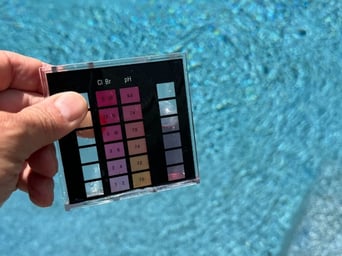
Water quality should not be treated as an afterthought once construction is complete. Large reflective basins
Require professional oversight of fill strategy, treatment startup, sanitation control, circulation performance, and algae prevention from the outset.
Why did algae return so quickly to the Lincoln Memorial Reflecting Pool?
Was the Potomac River the water source for the Reflecting Pool?
Was the water untreated when the Reflecting Pool was refilled?
Why is the blue coating peeling off the Reflecting Pool?
Did vandalism cause the Reflecting Pool coating failure?
What does this mean for pool owners, fountain owners, and anyone managing a water-holding structure?
The lesson is simple: do not treat a finished failure as only a finished problem. Any pool, fountain, reservoir, or tank should be evaluated as a complete system that includes structure, waterproofing, joints, hydraulics, circulation, source water, treatment strategy, and long-term maintenance planning.
The Lincoln Memorial Reflecting Pool deserves better than a surface-level diagnosis.
The visible peeling now drawing public attention may be only one layer of a broader story involving joint performance, substrate conditions, water quality management, sequencing, compatibility, and maintenance realities. That does not mean the full system has failed. It does mean the final answer should come from disciplined forensic analysis, not assumptions or alleged vandalism.
For owners of pools, fountains, reservoirs, and decorative water features, the lesson is clear: when a finish fails, do not stop at the surface finish coat.
Ask what the structure is doing, what the water is doing, what the joints are doing, how the water is being treated, and what the operating environment is asking that finish to withstand. That is how long-term solutions are built.
If you are in Los Angeles and need an experienced perspective on a pool renovation, waterproofing concern, recurring algae problem, or a finish system that may be masking deeper issues, J Designs Pool & Spa is available to help evaluate the full picture before costly decisions are made.

 JC Escudero: Sep 23, 2026
Planning a custom pool involves dozens of decisions about shape, depth, materials, and features. Get one wrong, and you could face expensive rework...
 JC Escudero: Sep 19, 2026
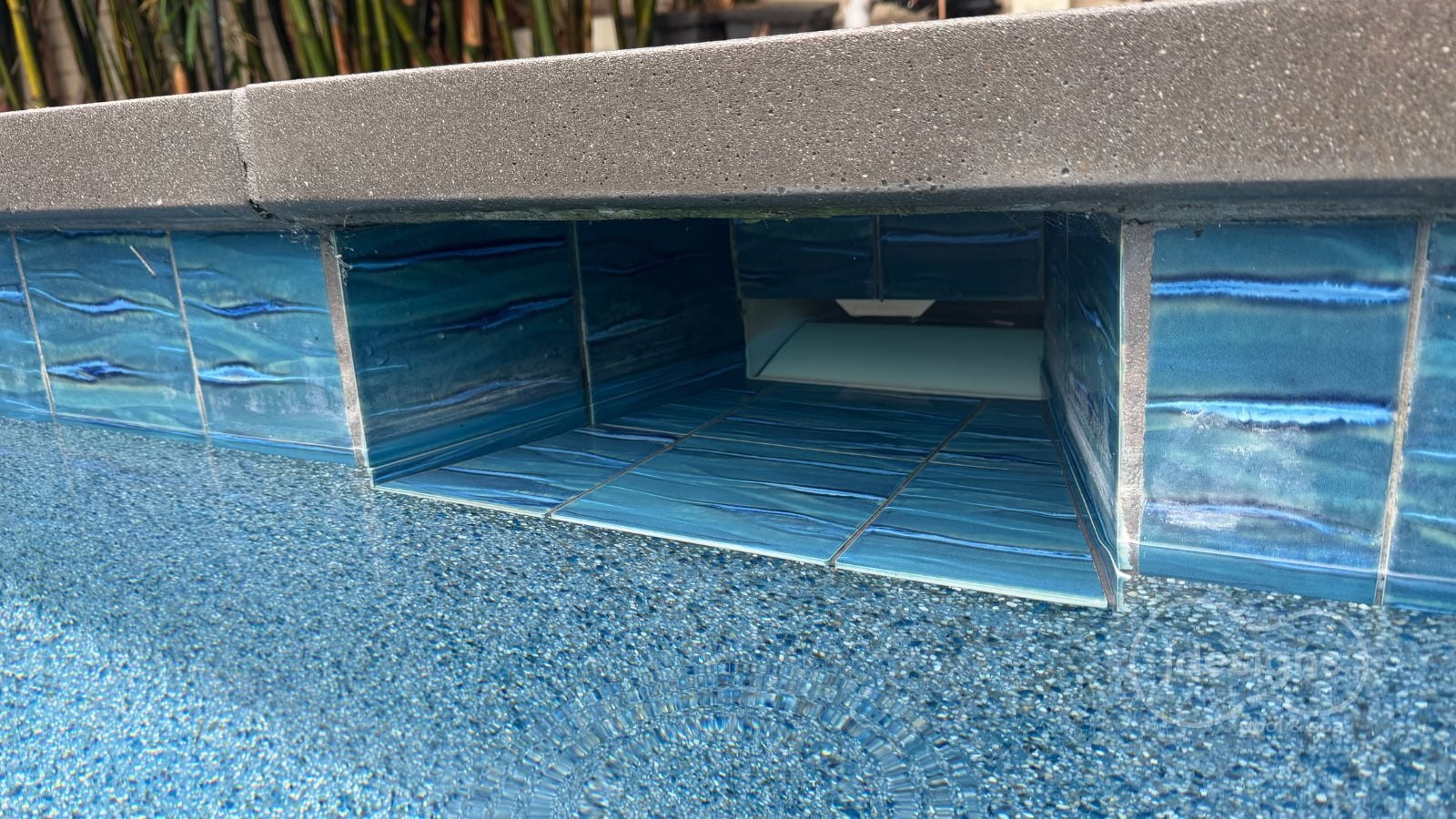
Your pool's circulation doesn't simply begin at the pump.
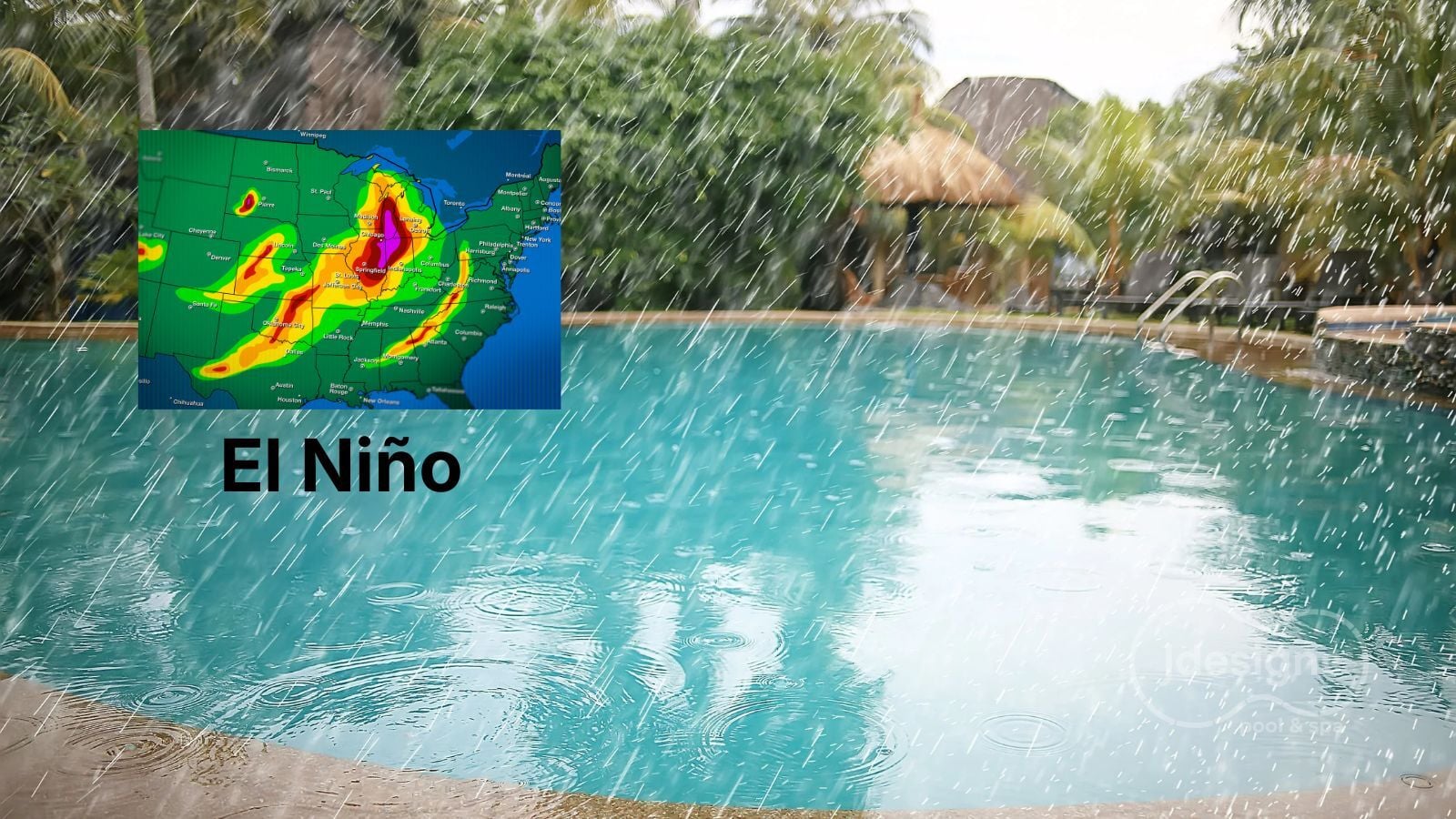
After heavy rain, don't automatically shock your pool or add chemicals. Test the water first.
 Daniela Escudero : Aug 29, 2022
Experiencing pool delays? J Designs will give you the most up-to-date news regarding your pool and pool building experience.
 Daniela Escudero : Aug 31, 2022
Expertly designing custom pools & spas since 2008, J Designs will give you the most up-to-date news regarding your pool and pool building experience.
 JC Escudero : Aug 8, 2026
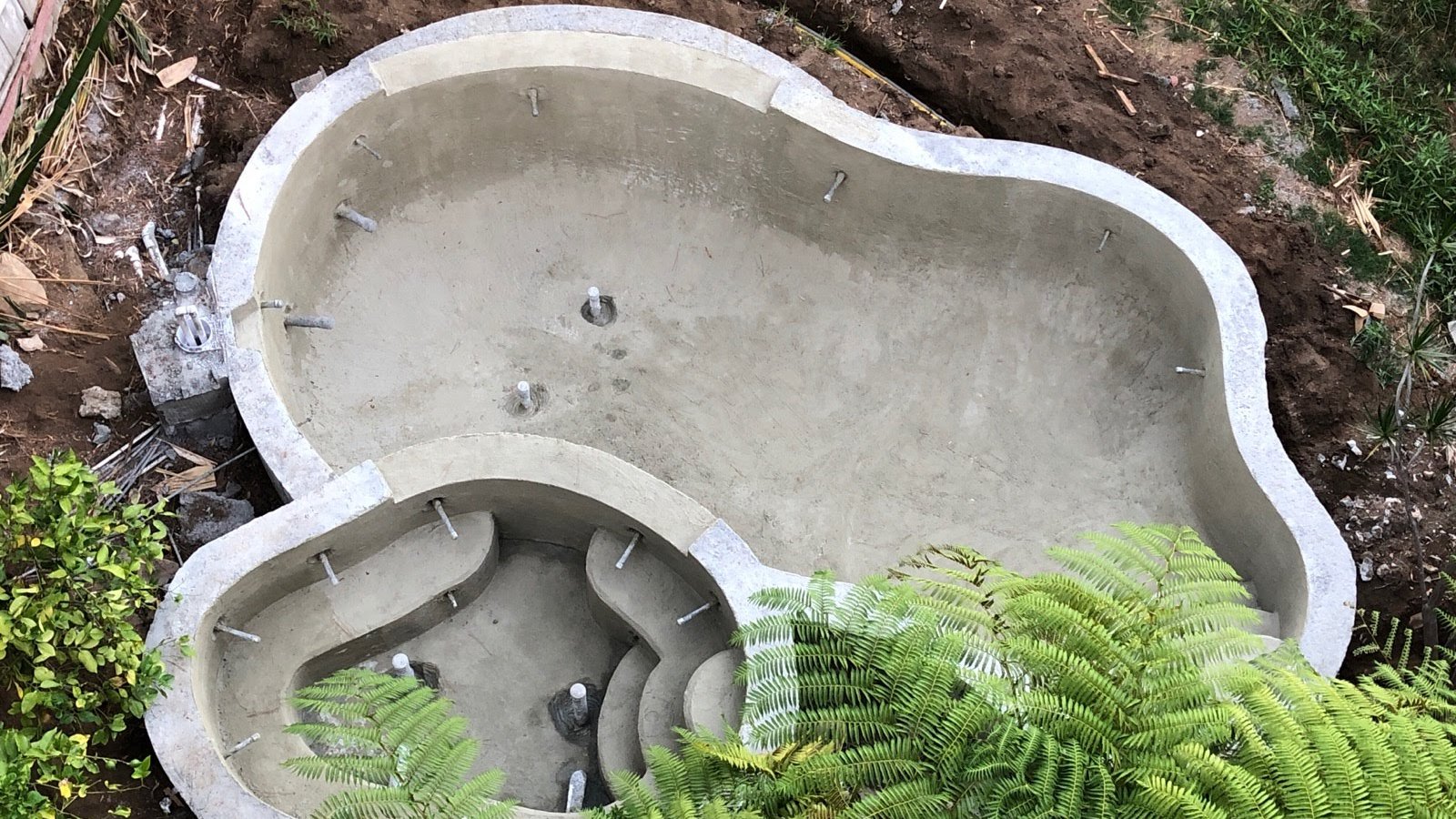
Learn how an existing pool can be safely expanded or reshaped using engineering, steel, inspections, and shotcrete, resulting in a long-lasting...