
Stainless Steel Pools in Los Angeles: When Do They Make Sense?
 JC Escudero: Oct 1, 2026
When most homeowners picture a swimming pool, they probably picture a concrete or shotcrete structure built into the ground.
9 min read
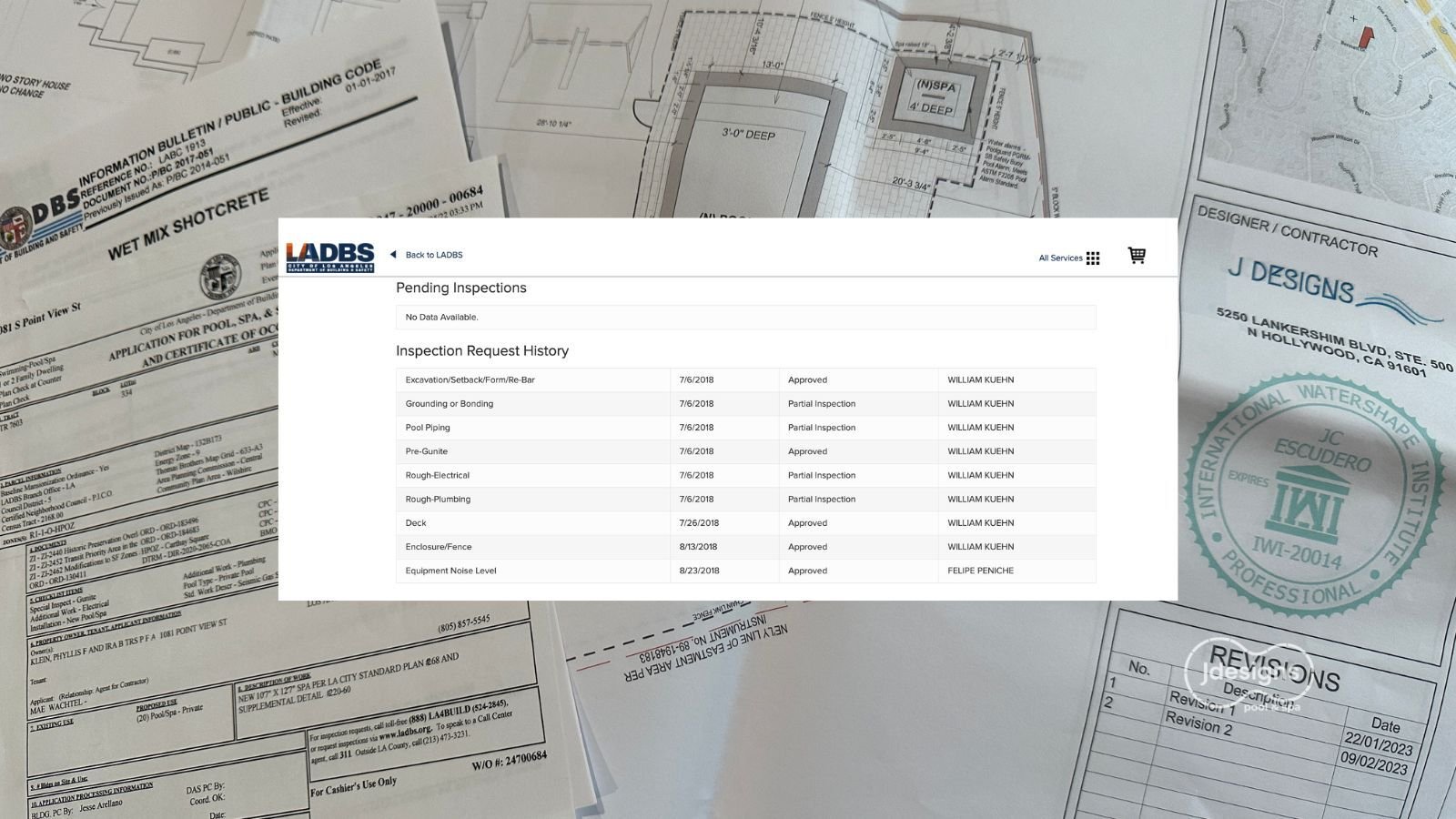
An unpermitted pool in Los Angeles is more than a missing permit. It may also mean there are no approved plans or inspection records confirming how the pool shell, reinforcing steel, plumbing, electrical bonding, drainage, equipment, or safety barriers were built.
That uncertainty matters when buying or selling a home. A pool can have fresh plaster, new tile, and attractive landscaping while older structural, leak, drainage, or equipment problems remain hidden beneath the finish. Cosmetic improvements may improve a pool’s appearance without resolving the underlying condition.
For buyers, missing records may affect due diligence, negotiations, insurance, financing, and future repair costs. For sellers, known unpermitted work may create disclosure and closing concerns. The right response is not to assume the pool must be demolished, or that it is safe simply because it looks good.
Start by comparing the existing pool with the available permit and inspection records.
This article explains how to investigate an unpermitted pool in Los Angeles, understand potential fees and corrective work, identify hidden risks, and make a more informed decision before you buy, sell, or remodel.
An unpermitted pool is more than a missing document. Depending on the work, permits and inspections may have verified plans, engineering, structural construction, plumbing, electrical bonding, drainage, and safety features before the work was concealed.
A finished pool can look clean and well-maintained while leaving unanswered questions about what lies beneath the plaster, decking, and landscaping. Missing records do not automatically prove the pool is unsafe, but they make it harder to verify how it was built and whether the work was inspected and finalized. For buyers and sellers, that uncertainty is why the pool’s records and physical condition should be evaluated together.
Before assuming that your pool is illegal or unpermitted, research the property's records.
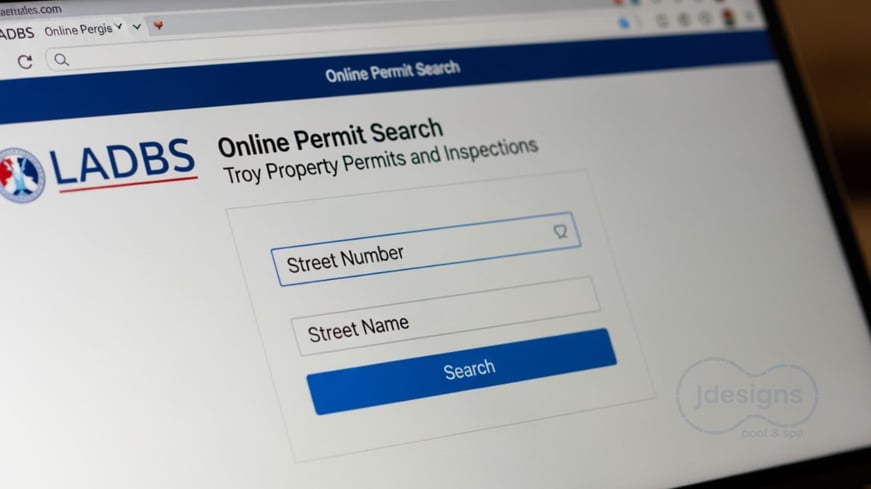
Start with the property’s permit and inspection records before concluding that a pool is unpermitted. For properties within the City of Los Angeles, review LADBS records and ZIMAS for the original pool, later additions or renovations, structural work, plumbing, electrical systems, equipment, decking, retaining walls, inspection history, and final approval.
A permit alone is not enough. Confirm three things:
If the records and existing pool do not match, or a later renovation appears to lack documentation, additional investigation may be appropriate before buying, selling, or remodeling.
Construction performed without required permits can become a code-enforcement issue in Los Angeles.
However, homeowners should be careful not to assume that every unpermitted pool will have the same
outcome. The city's response can depend on the work involved, the property's circumstances, the violations identified, existing records, and what is necessary to demonstrate or achieve compliance.
A homeowner could potentially be required to obtain permits and provide plans or other documentation for existing work. Depending on the circumstances, additional investigation could also be necessary.
If concealed construction needs to be verified, portions of the finished work may potentially need to be exposed. If deficiencies are discovered, corrections may be required before approval can be obtained.
The important point is that paying a fee or obtaining a permit after construction does not automatically prove that everything already built will be accepted exactly as it exists.
This is where an apparently inexpensive permit problem can become a much larger construction problem.
What are the fines and fees for an unpermitted pool in Los Angeles?
One of the most common questions homeowners ask is:
"How much is the fine for an unpermitted pool?"
Unfortunately, there isn't one number that accurately describes every homeowner's potential financial exposure.
Under Los Angeles Municipal Code Section 98.0402, qualifying work that commenced without the required permits or authorization may result in a special investigation. The code establishes an investigation fee generally equal to twice the applicable permit, license, or application-for-inspection fee, with a minimum investigation fee of *$400, subject to the provisions and exceptions contained in the ordinance. * Rates published at the time the blog was published.
That does not mean "$400 is the fine for an unpermitted pool." The investigation fee can be only one part of the cost.
Depending on the circumstances, a homeowner could face expenses associated with:
Los Angeles Municipal Code Section 98.0411 also establishes noncompliance fees in qualifying circumstances when an order is not complied with within the required time.
This is why homeowners should focus on more than the initial "fine." The potentially expensive question is what it will cost to demonstrate that the existing pool complies, or to correct it if it doesn't.
A relatively small municipal fee can become secondary if investigation reveals substantial structural, electrical, plumbing, drainage, or safety problems.
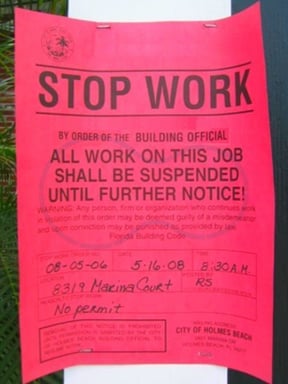
A stop-work order will be issued until all plans, permits, and fees are settled; the City will lift the stop-work order. In addition, corrective work may be required, and we have heard that removing structures is often a condition due to the hazard they pose to neighbors, especially on Hillside properties.
But homeowners should also be skeptical of blanket statements such as:
"If the city finds out, they'll make you demolish the pool."
Depending on the circumstances, possible outcomes could include obtaining documentation and permits, engineering evaluation, exposing concealed work, making corrections, reconstructing deficient components, or more substantial alteration when existing conditions cannot remain.
The fact that a pool has existed for 10, 20, or 30 years does not by itself establish that it was properly permitted or constructed.
Likewise, the fact that previous owners used it without any obvious problems does not establish that the concealed construction meets applicable requirements.
Before assuming the worst, or assuming there is no problem, find out what actually exists.
This is one of the biggest misconceptions we encounter around existing swimming pools. People naturally judge a pool by what they can see.
Is the plaster clean? - Does the tile look good? - Is the water blue? - Does the equipment turn on?
Are there obvious cracks?
Those observations are useful, but some of the most important components of a swimming pool are hidden after construction is completed. A permitted construction process provides opportunities to evaluate required work at stages when those components are still accessible.
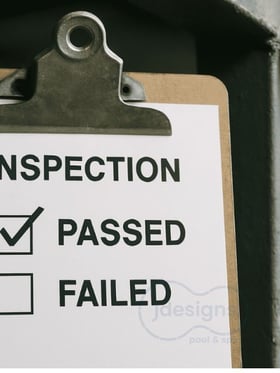
When those inspections never occurred, or there is no record demonstrating that they occurred, you may have unanswered questions in several important areas.
The reinforced concrete or gunite shell is one of the most important structural components of a swimming pool.
Potential concerns in poorly constructed pools can involve reinforcing steel placement, concrete or gunite installation, penetrations through the shell, structural transitions, bond beams, steps, raised spas, and other details. Once everything is covered by the pool finish, much of that construction is difficult or impossible to visually evaluate.
This is where real engineering and construction experience matters: the symptom visible at the surface may not tell you the complete story underneath it.
Los Angeles properties can present challenging site conditions.
Pools may be constructed near slopes, retaining walls, structures, property lines, or areas with complicated soil and drainage conditions.
Depending on the property, concerns may include settlement, undocumented fill, poor backfill, inadequate drainage, soil movement, or site conditions not properly considered during construction.
This becomes particularly important when investigating cracking or movement.
Repairing a crack without understanding why the pool moved can treat the symptom while leaving the cause untouched.
Most pool plumbing disappears underground before the finished deck and landscaping are installed.
Problems can include leaking lines, poor connections, inappropriate pipe sizing, unsupported plumbing, problematic shell penetrations, or inefficient equipment configurations. A renovation can make this particularly complicated because new plumbing may have been connected to much older existing systems.
Swimming pools combine water, electrical equipment, pumps, lighting, metal components, and people in a single environment.
That makes electrical installation and bonding a life-safety concern, not merely an equipment issue. An unpermitted pool should not automatically be assumed to have defective electrical work. However, when required inspections were never completed, you may not have an inspection record verifying that concealed electrical and bonding components were installed as required.
The existing pool's electrical system, it should be evaluated by an appropriately qualified professional.
A leaking pool can be much more than an inconvenience.
Leaks can occur through plumbing, cracks, penetrations, skimmers, waterproofing transitions, raised spas, or other components. Depending on the location and severity of the leak, water migration can potentially affect surrounding soils and improvements.
This is another reason simply resurfacing an older pool without investigating the cause of an existing problem can create expensive surprises later.
Pool safety does not stop at the edge of the water. Barriers, gates, doors, alarms, and other required safety measures can play an important role in reducing drowning risks, particularly for young children.
LADBS identifies missing pool gates or fences among conditions that can become enforcement issues.
If you're purchasing an older property, do not assume that an existing fence, gate, or barrier arrangement is compliant simply because it has been there for years.
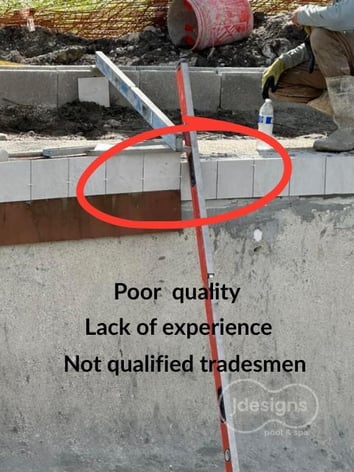
At J Designs Pool and Spa, some of the concerns we have encountered when evaluating existing pools include:
The goal is not to suggest that every unpermitted pool contains these defects. Instead, our experience has taught us something important:
You cannot determine the quality of concealed construction from the appearance of the finished pool alone.
This is why we recommend investigating the actual condition and available construction records rather than making assumptions based solely on appearance or age.
Discovering an unpermitted pool while preparing to sell can be stressful. But hiding the issue or hoping the buyer never discovers it can create much bigger problems.
California residential real estate transactions include disclosure requirements addressing known conditions, including questions concerning alterations or repairs completed without necessary permits and work that may not comply with building codes.
Because the exact disclosure obligations depend on the transaction and circumstances, sellers should discuss their specific situation with their real estate professional and, where appropriate, a qualified California real estate attorney.
From a construction standpoint, however, there are several questions worth answering before listing or before getting deep into escrow:
Answering these questions earlier gives you more options. Discovering them days before closing generally does not.
If you're considering buying a home with an undocumented pool, don't evaluate the issue solely by asking:
"Does the pool work?"
Instead, investigate it from three different perspectives.
Determine what permits and approvals exist and whether they appear consistent with the pool you see today.
Have the pool evaluated for visible signs of deterioration, leakage, movement, equipment issues, safety concerns, and other deficiencies specific to the property.
If the condition of the pool, property, or records, or visible defects, raises structural, geotechnical, electrical, or other specialized concerns, consider whether an evaluation by the appropriate licensed professional is warranted.
A conventional home inspection, a pool equipment inspection, a municipal records search, and a structural engineering evaluation answer different questions.
Do not assume one automatically replaces the others.
Depending on what your investigation reveals and the terms of your purchase agreement, you can then discuss available options with your real estate and legal professionals.
Those options may include requesting further investigation, asking the seller to address certain issues, negotiating the transaction based on anticipated costs, or deciding that the uncertainty and potential expense exceed your risk tolerance.
This question deserves special attention because buyers sometimes assume that an old violation remains solely the previous owner's problem.
Do not assume that purchasing the property makes the construction legal, or that responsibility for dealing with the physical condition disappears because someone else originally built it.
A real estate transaction transfers ownership of the property. It does not retroactively establish that undocumented construction was permitted, inspected, or approved.
A useful way to remember this is:
Escrow can transfer ownership of the property. It cannot turn unapproved construction into approved construction.
The allocation of legal or financial responsibility between a buyer, seller, contractor, or other party can depend on facts well beyond the scope of this article.
If you're facing an actual dispute involving nondisclosure, code enforcement, contractual responsibility, or significant financial exposure, obtain advice from an appropriate California real estate attorney.
In some circumstances, existing work may undergo a permitting and approval process after construction.
But homeowners should understand what this process does and does not mean.
A retroactive permit is not simply a fee you pay to make the problem disappear.
The city may need sufficient information to determine whether the existing construction satisfies applicable requirements.
Depending on the circumstances, that can potentially involve:
This is why two apparently similar unpermitted pools can have dramatically different paths toward resolution.
One may have adequate documentation and relatively straightforward corrections.
Another may contain serious, concealed deficiencies that require substantial work.
Until the records and physical conditions have been evaluated, be cautious about anyone promising that an unpermitted pool can be "legalized" for a fixed amount without first understanding what was built.
In Los Angeles, an unpermitted pool should not automatically make you walk away from a property. In some cases, these can be a huge liability, and that's when things get concerning, including the cost of retrofitting and inspecting the pool to obtain the proper approvals. It also should not be ignored simply because you love the house.
The better question is:
How much uncertainty are you buying along with the property?
If records are missing, but the construction can be thoroughly evaluated, and the path forward is reasonably understood, you may decide the risk is manageable.
If significant structural concerns exist, documentation is poor, engineering questions remain unanswered, or the cost of compliance cannot be reasonably estimated, your decision may be very different.
The purpose of due diligence is not necessarily to eliminate every imperfect property.
It is about understanding the problem well enough to make an informed decision, rather than inheriting an unknown construction problem from someone else.
An unpermitted pool is not automatically unsafe, nor is it automatically a demolition project. But it is an uncertainty that should be investigated before you commit to a purchase, list a property, or invest in a cosmetic remodel.
Start by comparing the available permit and inspection records with the pool that exists today. Look beyond plaster, tile, and landscaping. Structural movement, leaks, underground plumbing, electrical bonding, drainage, equipment, and safety conditions may require separate evaluation.
If you are buying, selling, or remodeling a Los Angeles pool with incomplete records, contact J Designs Pool and Spa to schedule a consultation. We can help assess the pool’s existing condition and determine whether additional inspection, engineering, or construction investigation is warranted. Our inspection services article explains how we guide you through the process and is a great way to start your journey into your new home.
The goal is not simply to make an old pool look new. It is to understand the property, address problems honestly, and move forward with confidence.
 JC Escudero: Oct 1, 2026
When most homeowners picture a swimming pool, they probably picture a concrete or shotcrete structure built into the ground.
 JC Escudero: Sep 26, 2026
When most homeowners choose tile for a swimming pool, they naturally focus on the tile itself: the color, shape, texture, and overall design, because...
 JC Escudero: Sep 23, 2026
Planning a custom pool involves dozens of decisions about shape, depth, materials, and features. Get one wrong, and you could face expensive rework...
 JC Escudero : Aug 8, 2026
Learn how an existing pool can be safely expanded or reshaped using engineering, steel, inspections, and shotcrete, resulting in a long-lasting...
 JC Escudero : Jul 4, 2026
A pool expert explains the Lincoln Memorial Reflecting Pool failure, algae return, coating issues, and what may have gone wrong.
 JC Escudero : Mar 9, 2025
Wildfires in LA? Learn to assess the fire damage and restore your pool and backyard with expert help from J Designs Pool & Spa.